



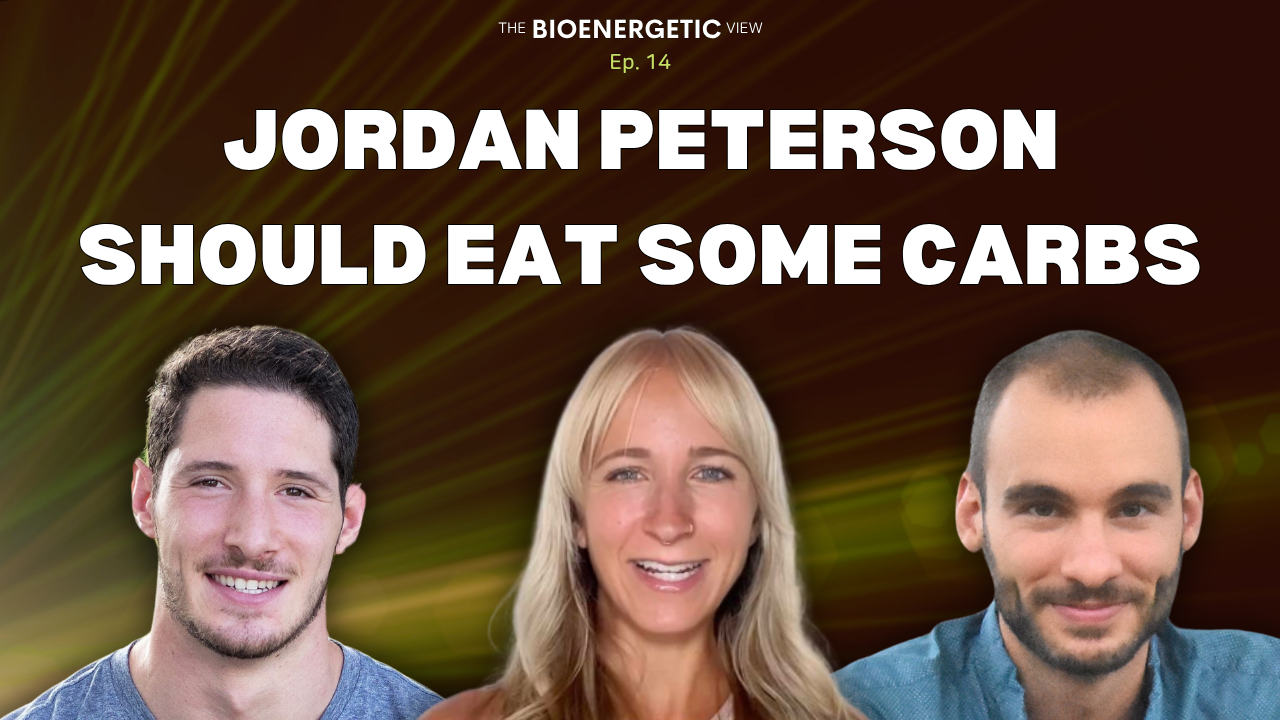
07 Jul 2025 BV #14: Carbs Are NOT Essential, Should You Eat Them? And Bill Burr on Fasting
Listen to the podcast on Apple Podcasts | Google Podcasts | Spotify
In this episode we discuss:
0:00 – intro
0:32 – Max Lugavere and Jordan Peterson discuss the idea that carbohydrates are not essential
7:42 – carbs ARE essential to our physiology
15:24 – Bill Burr discusses his fasting practices with the goal of fat loss
23:18 – fasting concerns and the problem with using restriction and willpower for weight loss
27:10 – Bill Burr is an example of how food restriction and fasting causes food obsession
32:52 – why sugar cravings do NOT mean that you are a sugar addict
38:48 – what the Minnesota Starvation Experiment teaches us about restriction
40:16 – the psychological and emotional harm caused by fasting
50:31 – Bill Burr’s fear of spiking blood sugar levels
53:19 – if fasting makes you feel better, it's a sign your diet isn't working
Theresa Piela
All right, welcome to episode 14 of the Bioenergetics View. I'm your host, Teresa Piela, joined as always by Jay Feldman and Mike Fave. Today we'll be talking about whether or not carbohydrates are essential and unpacking ideas around fasting for fat loss, especially for those who struggle to lose weight in any other way. So let's get started with this first clip from around the internet with Jordan Peterson and Max Lugavere.
about whether there's a, if carbohydrates are essential or not there's no such thing as an essential carb.
Right. That's something to be said repeatedly because that's really kind of shocking It is. We have, you know, a daily requirement for certain essential fats, fatty acids like omega-3 and omega-6 fatty acids. Protein is massively important. There's no such thing as an essential carbohydrate, which isn't to say that you shouldn't eat them. but it's very essential. Correct.
Mike Fave
Strange, that's not as…
Theresa Piela
All right. Every time I hear someone talk about how they're not essential, I always get hungry. Jay, was that your reaction too when you watched this clip?
Jay Feldman
I don't think it was, I mean, I think. It's, it, is one of the most common arguments that we hear throughout any anti-carb sphere, which Jordan Peterson kind of lives in. And it's, we see it on our comments. We see it everywhere. It's one of the most popular arguments and it's one of by far the weakest arguments. I mean, we talk about, you know, the idea of trying to mimic our ancestors as if we could identify exactly what they did. And the fact that you know, if they did it, it must be healthy. And we talked through that and the weakness of those arguments. talk about, you know, bad analogies comparing us to other animal species, and things like that. And I mean, there's a lot of bad arguments out there, but I think the essential carbohydrate one has to be one of the worst, especially because it seems to be, it seems to really sway people, which is frustrating as well, because I think people just don't understand what that actually means when we're talking about something being essential and what the implications are of that or are not of that when it comes to the physiology. And, you know, I think it says something too, that Jordan Peterson finds this point so, so important that it's worth repeating and that it's shocking and strange. know, it's like he's, it's one of those things where he's trying to say something without actually saying something. Obviously he's trying to say that because they're not essential, maybe we shouldn't be eating them and, or we should be eating very few of them.
And I think the first point to get out here is when we're talking about nutritional essential essentiality, this isn't about whether something is a nutrient that's important. It's not talking about whether it's essential to our physiology or to tons of different processes in the body. What it is referring to is whether something is dietarily essential, meaning that the question of whether we need to have it in our diet to survive. the reason why, I mean, they're kind of short of the reason why carbohydrates are not essential is because we can produce them.
We have a process called gluconeogenesis that we can rely on that allows us to produce carbohydrates from other substrates. Normally it's from amino acids, but also from some fatty acids and glycerol backbones and things like that. And so this is something that's actually conserved across all species in the animal kingdom. never, I don't know of any, and I looked a little bit to try to find any that don't have this process of gluconeogenesis to rely on.
And I don't think that any exist because of how important carbohydrates are. So it's true that they're not essential to the diet because we can produce them, but they are incredibly important to our physiology, to every single cell and tissue in our bodies, to the point that every single species in the animal kingdom can produce them so that if there's not any in the diet, then we don't die. you know, we can still function and survive and get through that sort of period of time.
So there's this conflation of essentiality with importance, I think is the first thing. And then the second thing being that just because they're not essential in the diet doesn't mean we want to rely on our own systems for producing those carbohydrates because there's going to be inherent inefficiency there. And it provides a signal if we're relying on our own gluconeogenic pathways to get our carbohydrates, it's providing a signal that our environment is generally one of scarcity that doesn't have a lot of nutrition available, which we need.
And it goes along with other signals that turn down our metabolic rate, considering that the main drivers of gluconeogenesis are stress hormones like glucagon, adrenaline, and cortisol, which not only drive gluconeogenesis, but also try to turn down our metabolic rate by reducing thyroid hormone production and conversion, lowering reproductive steroid hormone production, and a number of other things so that we can survive during suboptimal time periods. there's truth. Like it is in It is objectively true that carbohydrates are not dietarily essential. is not worth repeating. Like Jordan Peterson said, it's not shocking or strange. It's pointing to how important carbohydrates are to our physiology. And it's telling us, it doesn't say anything about whether we're better off or worse off including them in our diet. at, at worst, like at worst, it's saying nothing at best. think you could actually just from that argument, take the idea that it actually would be a good thing to be getting them from our diet. So we don't have to produce them.
Now, the other part of this that's so frustrating is that 95 % of the other food you consume is also not essential, even on a low carb diet. So people point to the fact that there are essential fatty acids. There are two, there's omega-6s and omega-3s, but guess what is not essential? Saturated fats and monounsaturated fats. But nobody who's consuming a low carb diet is saying, I'm only going to eat omega-6s and omega-3s because those are the essential ones. The reality is that the vast majority of their calories are also coming from non-essential nutrients.
Mike Fave
in monounsaturated fats and saturated fats. Again, they're not essential because we can produce them. You could have zero monounsaturated fat and zero saturated fat, and you can produce them from carbohydrates that you consume. using the exact same argument, this would be saying that you shouldn't be eating any monounsaturated fat or saturated fats. You should only be eating omega-6s and omega-3s. And when we look at protein, it's very similar. There are nine essential amino acids. And for an average weight person, about 150 pounds,The requirement for essential amino acids is 13 grams a day. So if you're only eating nutrients that are essential, you would eat 13 grams of the essential amino acids. You would eat maybe one or two grams of omega-6s and omega-3s that are potentially essential. That's debatable anyway, but let's say we're assuming that that's the case. That's, that's going to be our diet. have it two grams of omega-6 and omega-3 total, like some, you amount between those two, 13 grams of amino acids, and you have your perfect diet based on this argument.
And it's. Obviously absurd. Obviously the fact that these things are not dietary, dietary essential doesn't mean that they're not important in our diet. It doesn't mean that we don't want to consume them. And these people don't believe it either. They just don't know that because they're not actually thinking about it. At least it doesn't seem like Jordan is obviously Max mentioned like that doesn't mean you shouldn't consume them, but even mentioning this is providing the insinuation that maybe we shouldn't be consuming them. We should be consuming less of them. definitely sounded like Jordan was suggesting that. And obviously we know diet wise, that's generally what he does. So It's frustrating to see hopefully one day enough people will recognize the absurdity of that claim and suggestion and people will stop saying it.
Mike, did this frustrate you too? Shocking. It was shocking. Should we say it again? Yeah, it needs to be said endlessly. Like we just need to keep saying it. I think the way that I would take this is that carbohydrates are so essential to our body's functions in general that if we cannot get them from the diet, we synthesize them endogenously. I think that would be the better way to frame this argument and say that over and over again.
Mike Fave
I think that needs to be said over and over again because that's basically what happens, right? You will break down all types of tissues, your muscles, your fat stores, your connective tissue, all different components using in hormonal systems dedicated to this process to make carbohydrate to make glucose and your body absolutely cannot run without glucose period. Like there's like if you don't have if you completely eliminated glucose in the body, you would you would, couldn't function. The central nervous system would, would get, would stop functioning even if you have ketones present. So these are things that it's like, I think if you reverse the frame and you put the frame appropriately, then it starts to make sense. And if you then apply that same frame to the polyunsaturated fats, when you actually look at the true requirements for polyunsaturated fats, for an adult, there's, there's estimates that's talking about like 0.5 % of calories.
Like we're talking about such a low amount that it's like you cannot on a normal diet induce an essential fatty acid deficiency like a normal everyday diet. Even if you're trying you would really have a hard time doing it. The only way they've done it in human studies is with parenteral feeding and then also in like giving a gentleman that I think it was hydrogenated coconut oil and like well, like starches and casein protein that had had all the fat stripped. It's like there's a there's like it's like absurd to even point that as the opposite. Well, we have essential fatty acids like when exceptionally low requirement that you couldn't ever create a deficiency of in a normal eating context for an adult. You're almost like almost impossible. And then even with the Omega sixes, there's question around like how like how much you even need to get for an adult period.
And the major arguments are really centered around the long chain of mega 3s for infant development. That's where you see like the most controversy is DHA and infants. And even then requirements are still exceptionally low. And when you get to adults, it's like starts to get to be questionable around what the true requirements are. So I think these types of things, when you frame it that way, it's like maybe there's a reason that your body doesn't produce large amounts of polyunsaturated fats.
Jay Feldman
And you only need exceptionally low amounts coming from the diet. It's like you could flip the perspective and change the frame here and you start to see, okay, well actually we really need glucose to the point that we will degrade our own tissues to produce this nutrient. And so I think for me, when I hear this type of stuff, it's like, it's again, it's like a tangential argument. It's kind of a nice sound bite that, well, you don't need to eat carbohydrates, but to live, but it's besides the overarching point physiologically. And I think Jay pointed out well, it's like even people who are not eating carbohydrates like the other food sources that they're having aren't essential either. So it just gets into the semantics around what is essential and what's not essential and gets us directs us away from talking about what is the appropriate amount of the different nutrients both macronutrients and micronutrients that we need as humans or as individuals to thrive. I don't really care anymore about what's essential and what's not essential.
It's more about what is the optimum amount of this thing, right? And even the people in these camps, in the low carb camps, will get into perspective where they're like, well, the RDA is like, they just are the amounts that we need to prevent deficiency and we need high, we arguably need higher amounts of these certain things so that we can function optimally in terms of vitamins and minerals. And then at the, in the same breath, we'll then be like, well, carbs aren't essential. And it's just like the, the level of reasoning across the board, it's not, it's not congruent.
So I think in general, let's just move the entire conversation to what is, what do we need to optimally function and thrive? Not what is like this like minimum required essential component from the diet type of type of deal. Like that's step one. Step two is then let's get to optimal, right? Cause then there's arguments even on our end and out even from the low carbon of keeping the polyunsaturated fats, even though they're essential pretty low.
So like, again, it like flies in the face of the, of this general picture here. And I think that it just obfuscates like what we're trying to like figure out here with the dietary components. So I don't think we need to say this over and over again. I think it's like, I it's already been said over and over again. Well, it, think Jordan's late to the party with this idea. Like this has been going on for years now. This perspective of, you don't need to eat any carbs. They're not essential. It's like essential to what? To, you're making it from your tissues.
The frame is so interesting. It gets me thinking more about how we frame anything can change the meaning it has for us. And even just thinking, okay, know, friends, let's say they're not essential and someone frames it like, I don't need them then, right? Because they're not essential. We could flip that around. Like you were just saying, Mike, and thinking more about, well, what's optimal? And especially in the world of kind of chronic illness or complicated health pictures, some of these things that might not be essential actually might be the most essential when we start to understand the impact it has on our functioning and our physiology. yeah, yet another reminder to really question how things are being delivered and the emotion and fear behind it and starting to think more about what is closer to the truth for you, not what these influencers are saying.
Yeah, that's a great point. I was just thinking, you know, what else is not essential making your bed. You that's his number one recommendation.
John's fired. is that one of Jordan Peterson's?
Yeah, remember one rule for life.
Yeah, I've heard it. It creates a more successful life.
It's debatable whether it's essential for that.
I don't have anything else to say here.
I think we've beat this topic on its head so many times.
Yeah, it's obliterated.
When it comes to creating a diet for optimal health, there's a lot of conflicting information out there. And that's why I've created the Energy Balance Food Guide to help you determine exactly what to eat, to optimally support your metabolism and help you lose weight, improve your digestion, get amazing sleep, boost your energy and so much more. The Energy Balance Food Guide is a one page infographic that organizes foods on a spectrum based on how effectively they support your metabolism. And it also has a separate spectrum that adjusts the scale for you n the case that you're dealing with various digestive symptoms, the food guide makes it extremely easy to get started with a bio-energetic approach to optimizing your health. So head over to jfeldmanwellness.com slash guide to download your free energy balance food guide.
Let's move on to Bill Burr while we are having some fun here. So we've got some fun clips talking about his experience with fasting for fat loss specifically, but as we'll get into how fasting might be shifting his constant thoughts about food and just his brain function in general, so.
Oh Billy, oh Billy, Billy Fast Face, Billy Fast, the first three days of every month now. And I am, let's see, I started Thursday night at 10.30, it's 10 to seven on Sunday everybody always goes, you know, when you fast, you know, it's, it's not fun at first. And then there's just like this euphoria that just takes over and you just feel like, my God, I felt amazing. but anyway, I did do yoga and, with the fasting, I did feel like, yeah, this feels pretty amazing. But then of course I always have to do. So the second the tape was over, you know, I think when you fast, you're supposed to like, I don't know what you're supposed to not do anything. But I mean, I don't know. I'm just doing it for vanity purposes anyways. I just don't want to be a fat. That's all. I actually ran into this guy's pilot. I knew I didn't even recognize him. Guy had lost 80 pounds doing that intermittent fasting with like protein and cut out all the carbs. He looked unbelievable. He had zero percent body fat.
That's pretty amazing, you know what I mean?
Okay. Well, Mike, I know you are really excited to jump and jump on these clips and talk about, you've been bagging us for weeks now. Yeah. I just couldn't help myself. Just really wanted to talk about this. mean, I think there's a couple of things. I don't think Bill really said much of anything, right? I think he just kind of like rambling on about.
What he's doing with fasting and purposes and goals. But I think this is sentiment and a perspective that a lot of people experience. They see somebody else who fasted, they lost weight. The person said it was easy. They didn't have to restrict or control or to manage or to do anything else besides just like eating in this particular window. So think psychologically it becomes quite a bit easier to do things in this way. But the problem with this overall as there's a lot of people talking about fasting in this context and they don't let you know what the downsides are. They don't let you know what the long-term concerns are and how some of those concerns are actually directly contradictory to your overarching goal of losing body fat. And I say body fat specifically because losing weight is not necessarily the primary goal. And the problem and the reason I make this distinction is because if you are losing lean muscle tissue, when you finish your fast.
On top of the effects on the hormonal profile, the effects on having a lower lean body mass can dig you into a hole where your metabolic rate gets drastically decreased and then you are left with less food and a lot of people tend to rebound. You see this with the ozempic stuff as well where about I think 70 % of people fall off the drug at the two-year mark and then a year or two years after that, I think almost 70 % of the weight is regained. that's so one.
They lost, they likely lost lean tissue, which is why you're seeing some of the common trends of people talk like showing the their body calms after Ozempic. It's not being as good people looking a little bit more gaunt and then to the like there's negative impacts on the hormonal profile long-term. So this needs to be discussed and I, you know, I don't think Bill understands this and with something like a 14 hour fast or 16 hour fast with the research, it's not clear that mass amount of lean tissue will be lost as the rest of the diet is set up. So there's obviously a graded response. But when you start getting three days fast and seven day fast and things like this, the loss in lean tissue can be significant. You can see pretty significant loss of lean tissue. And they even see this in young men. I've made a video about this where in young men, what you can see is like a significant drop off in their lean muscle tissue, even after I think it was like a 10 day fast.
And so, the three day fast would be on par with that and it would have similar, I think you'd have just like a little bit less of the lean tissue loss plus you have decrements in thyroid function and androgens which that's been shown even in the like the 16-20 hour fasting context and increases in hormones like cortisol. So, yeah, you'll lose weight. If you had a lot of body fat, maybe you'll look a bit better but I think in the long run, there's negative hormonal concerns to it and then there's the loss of lean muscle tissue.
which I think is quite problematic from a long-term health perspective and also from a weight management perspective in the long-term and also from a metabolic perspective in the long-term. And you see even prominent people who used to fast like Dr. Peter Attia, who was doing three-day fast saying after I think it was a decade, he had lost, it was somewhere between 10 to 20 pounds of lean muscle mass with his fasting and he had to stop the fasting regimen.
And so this is why I think this is the major problem with some of the fasting stuff. Now, what is the alternative? I think if number one, if you set up the diet appropriately, right? You have adequate carbs, adequate protein, adequate fat. You organize your meals across the day and you look at your energy intake. You can lose weight consistently over time without massively damaging your hormones, without losing a lot of lean muscle tissue. You can actually increase your lean muscle tissue.
In this time frame, have clients who have done this. have women who are menopausal who have done this by setting up the diet appropriately. The trade off with doing something like this versus just saying I'm not going to eat for three days is that it takes a little bit more nuance and a little bit more know how in terms of how like of setting things up and running things on a consistent basis. So psychologically, maybe it's a little bit more difficult in the initial setup phase and only the initial setup phase.
And then after that, you just maintain the diet. You shouldn't feel stressed. You shouldn't feel bad and you lose the body fat over time. And then when you go back to like, you're not trying to lose weight anymore, shift your body comp, anything like this, you get into a circumstance where you're not really changing the diet that much. You don't have to go through this fasting, this feast, famine cycle. You just go back to your normal dietary intake that looks very much the same with what you were already doing currently.
So these are things like there's better ways to lose the weight without losing the lean muscle tissue, without trashing your hormones and coming out on the backend and knowing how to sustainably eat and maintain the progress that you've made over the long term. I think the fasting is like one of these hacks like the, that we get these, that people run, you know, I'm going to drop my carbs super low, I'm going to fast, I'm going to skip breakfast, whatever the thing is. And psychologically, it's like an easy intervention to set up but the long-term ramifications aren't discussed and there's way better ways to do this stuff appropriately. Yeah, I hear this all the time that skipping breakfast is, you know, like this new thing that a friend or a family member is trying. I listen, I keep my ears open and like you were saying, Mike, I think people hear all the good and the ease without taking into consideration some of the risks and that there might actually be another way to do it.
Theresa Piela
Jay, what were your thoughts with this video clip?
Jay Feldman
Yeah, I totally agree. And it's nice to have some insight here. And this is why we want to talk about it. We have some insight into how someone who is not really health oriented or like, you know, thinking in depth about health, how someone like that is thinking about fasting. And it seems to just fit into the category of other ways of restricting and using willpower to just eat less, but it's slightly easier than just eating less with each meal. You just skip a meal. And so you're, mean, hypothetically, not constantly thinking about food and wanting to eat more, although that definitely is not the case here with Bill. But yeah, the idea being like, this is just a way to eat less so that then you can have a better body composition. And as Mike pointed out, there's two really important things here. One is there's a direct cost to the fasting itself where you see down-regulated thyroid hormone conversion. So you see lower T3, the active thyroid hormone, and this
For again, the non-health oriented person who might not be aware of this means that you're more prone to regaining the weight after. It means that you're going to have lower energy because this is the main way that the main kind of driver of our energy production means you're going to have worse quality hair, skin and nails might notice like hair thinning and, and, you know, some brittle nails, things like that. It means you'll see lower body temperature. So that's something that you want to be concerned with or, you know, might it's a reason to maybe not go this route.
You also see decreased testosterone and the reproductive hormones, sex hormones from intermittent fasting. Again, I think that when people are a little bit more familiar with the concerns there, but then also decreased muscle mass as Mike was saying, and it's definitely more pronounced with the longer term fasts, but there are studies on intermittent fasting where they show it as well. There was a study where they did 12 weeks of weight loss diet. One group did intermittent fasting and one didn't. And this was put on by a doctor who had been recommending intermittent fasting to his patients was just fully excited about intermittent fasting as the strategy.
And he was so astounded by the results that he stopped recommending this to people because what they found was that the intermittent fasting group lost more muscle mass and didn't lose more body fat than the other group. It was better to just have your kind of normal calorie restriction without the fasting because of the stress induced causing more breakdown of muscle. So I think those are definitely reasons to hesitate with this kind of, you know, even though we hear maybe some of these very occasional stories about someone losing a lot of weight with fasting and it working really well for them. There are inherent costs to it. And as you were saying, there are better options here. can lose weight by fixing the underlying factors that are causing the weight gained in the first place, addressing blood sugar regulation, addressing our gut health, addressing our nutrient status, addressing our sleep, eating a healthy diet and fixing our ability to utilize the food that's coming in and lowering our stress hormones and upregulating our thyroid hormone activity, our thyroid activity and getting to a place where we're losing weight, not only without the drop in muscle mass and the, you know, low testosterone and T3, but also without constant restriction and hunger and cravings and constant willpower. And then all of the other things that we're going to see here from Bill about how he's basically obsessed with, with food and can't stop thinking about it because of what the diet is doing to him, how much stress it's causing, and basically just driving the signal to his body that it wants food it wants the exact thing you're depriving it of. And instead of figuring out the reason why the types of food you're eating, the other things going on physiologically are causing it to be stored as body fat, we're just saying the food is the problem and we're taking it all out, which is not actually looking deep enough to figure out what's going on. so then we end up with basically just causing starvation and there's consequences to that. One of those, in addition to the low muscle mass and testosterone and T3 and being prone to regaining weight, is also big food obsessed as we'll hear in the next couple of clips.
Yeah.
I mean, I just can't stop thinking of food. Do know right now what I would do right now? For a bacon, eggs and a coffee. God, I was making my son. I was cooking like all day today, bacon and cooking. Getting ready for the week where the kids. You know, I'm always, you know, I made banana nut bread a few weeks ago and now I just, I don't know why.
So the other day I looked up how to make, this is in the middle of the fast, I'm literally watching how people make croissants and a pano chocolat. The pano chocolat was ridiculous. I know this is bizarre. I've been on for 10 minutes. All I'm doing is talking about food. have another three and a half hours. The appreciation that you have for food when you fast is awesome. I sat for 10 minutes today and thought about how great it was that somebody came up with a breakfast burrito. and how I ended up making that was because I was watching. was like, you know what? I'm going to try and make some croissants. I mean, I'm not going to make croissants. I was just starving and I was watching people making food like I was watching online
And I came across those croissants a bit. man, homemade croissants. Can you imagine that those would be now amazing, right?
I think this is a pretty accurate representation of what all of us have experienced on a low carb or fasting structured diet. Mike, is this something you've experienced on your journey? So I want to tell a story here about Jay and I back in college together. You're ready.
I know the story that's coming. Jay is the master baker. Especially with coconut flour. Because obviously you can't use real flour. no. Because real flour has carbohydrates and coconut flour is mostly fiber. So Jay and I are running like low carb, cyclical keto dieting based on our workout regimen with intermittent fasting. It's like this, you know, extremely regimen of like you have a like a fast, like an intermittent fasting day with really low carbs. And you have like a moderate carb day and you have a high carb day and it goes with your different types of training. And then what we would have is like periodically we would have refeeds and those refeeds were usually on the weekends and it would often include Jay baking some type of low carb recipe that was like, like cookies or something like this. And it's basically exactly like, we just, I remember I would just look all week long, I would be waiting till the weekend so that we could absolutely binge food. so Jay had made these coconut cookies and I think we also, so we ate the coconut. What we would do, we had another roommate with us. We would sit on the couch. We ate the coconut, the coconut flour cookies. Obviously like, like ate way too many of them and got like 50 grams of fiber in one sitting from coconut flour. Felt terrible after, but still proceeded to eat a five pound bag of blueberries between the three of us and like paint our faces blue, just like shoveling in blueberries because we hadn't eaten enough carbohydrates and things like this all week long while we were still training and biking and doing all this activity. And this was the thing is like every day we wake up and just want food and we just crave food and like we could only have this amount of carb on this particular training day and then it would lead to this binging cycle. And then on the weekends we would binge.
Right? So that and that for me, that was after a year of doing hardcore intermittent fasting on a 16, 8 regimen with like less than 50 grams of carbs today. Extremely strict. Started to loosen up on some of the carbs a bit. So I had, you know, couldn't sleep, serious problems with this. But when we got into like on both settings, like always thinking about food, always hungry. And then when we went into that regimen, it just like that was into year like two, two, two and a half, something like this.
That was Like just all the time, constantly thinking about food. Now, when we then switched into a more pro metabolic, bio-energetics perspective, which essentially just adding carbs back into a large extent, I remember like all of those cravings went away. Like there wasn't this food obsession. There wasn't this craving anymore, the sugar addiction. Cause at that point in time is like, do you think the bacteria in our guts are just making us crave sugars? Like there's like these types of thought processes were going around.
And then like, or sugar's addictive, it's a drug, stuff like this. And we added cars back in and it was like in the form of fruits, plantains at that point, stewing, still doing starches, rice, things like this. And I remember the cravings just gone. Just don't, now it's just like I eat. I don't really have cravings for anything. I could see cookies or cakes or whatever else and it's not this circumstance. Like I really want to have that. Like I actually don't have the desire to have that.
And yeah, it was, it was a huge shift. That was like one of the big things that was extremely freeing. Once we got off the, that regimen is like this constant battle, having to restrict and avoid all these things. and like having like tons and tons of cravings and you know, telling myself I'm a sugar addict and in like running gut protocols, cause it's the microbiome and things like this. So it was, yeah, it was really great to get off of that. And it lines up with, with Bill's experience. And I think it, lines up with the hormones.
When you look in the studies, when people are put under stress, actually tend their, their taste for sugar becomes less, um, less pronounced in the sense that they will have to have more sugar, more sweet things to actually like have the reward signaled. And you see with, when people are under stress, cortisol increases their desire to eat these energy rich sweet foods. Cause I think that was something that a lot of people experience when they go on the low carb stuff over time, you really start to get these heavy cravings for carbohydrate. And I think part of that goes with some of the hormonal adjustments and especially with the fasting and whatnot on top of the restricting psychology that goes with these different diets. And then once you get out of it, I see this with clients all the time. They're like, it's kind of weird. I didn't think that this would ever happen, but I don't crave carbs anymore. Like I have my fruit and maybe rice or potatoes with my meal.
And then maybe I have some dark chocolate, mac nuts, things like this. And like, I just, like, I look at cake now, I look at cookies, I look at sweets, I look at these other things and I just don't want it. I just, I don't really care. I'm kind of indifferent about it. And it's because you already met the need and it's not an addiction. That's the important thing. This is not an addiction. This is your body telling you what it, what it needs to function optimally, not essentially optimally. Thank you for that distinction.
Jay, I didn't know you were a baker. I'm assuming that your tastes have shifted over the years away from coconut flour cookies?
Jay Feldman
Yes, I don't bake coconut flour cookies anymore.
Theresa Piela:
But when you think back to that time and having a similar experience, at what point did you, and I'm assuming you decided together, it seemed like you had a unique bond at the time, but when did you finally start listening to your body and that constant draw and pull towards food?
Yeah. I mean, it was, it was, you know, we were both doing our experimentation together, you know, kind of fueled each other, which was a good thing because I don't, before we even came across Ray's work, which was really the turning point. Mike was really the driver behind. I might've done the baking, but Mike planted the seed. He would encourage it. He bought the, the, the frozen fruit, you know, and as we very slowly started adding carbs in it, Mike would be the one to be like, you know, banana chips are mostly fat, you know, and it wouldn't, and instead of having a couple or a handful, we would finish a whole bag easily. you know, it's always started to bring those carbs in. And again, we had come from like really intense, low carbon intermittent fasting. it's, I'm glad that Mike was there to slowly help us introduce the carbs in, and, know, kind of give into the, that intuition and craving and desire, a little bit more because definitely helped propel that process forward.
But that of course, when we came across Ray's work, really changed our perspective entirely and allowed us to recognize that these weren't things that we had to fight against and we're just giving into, right? It wasn't the situation where we were wrong for not having the willpower to just keep forcing it, but rather every single cell in our bodies was telling us to eat carbohydrates and get that fuel in because we needed it. And so that allowed us a lot of freedom to get enough food in.
of go through a bit of a refeeding period where we were eating a ton, ton of carbohydrates. you know, initially I would, it's not like the carb cravings went away right away. And I want to point that out, you know, for anyone who's coming from low carb, I don't want them to think they're going to have a day where they eat 150, 200 grams of carbs or even 300 or more, and they're going to be fine. It takes a little while for your body to kind of adjust and actually feel like it's had enough of the fuel that it needs. But then you get to a point where
Speaker 2 (36:49.902)
It's not just like the cravings are gone. think that's how, um, you know, it's, it's like, when you're in that place, you think of it that way. It's like, crave carbohydrates and I'd like for that craving to be gone. But at least for me, it was a situation where this was the first time in my life since being a teenager where I wasn't actually hungry. And this actual recognition that hunger wasn't about like the amount of food in my stomach, like in the intestines, you know, it's not this feeling of like feeling physically full because I've.
I had been physically full many times, but I was still always looking forward to that next meal, um, to be able to eat more. I was always, I always would have eaten way more if I had given myself the permission to, obviously there were times where, you know, there was some binging and things like that. But even with the binging, there was no satiation there. When, you know, eating pizza, ate cookies and donuts when I'm, you know, when I was younger and, uh, and a teenager and kind of would go from restriction to that, some sort of a binge. You're, there's still no actual satiation there. And.
So when shifting toward, you know, more bio-energetic approaches, the first time in my life that I actually understood what it was like to not be deeply hungry and to actually be able to eat something and not even be physically full, but feel like I didn't want it anymore. And so that was really life-changing for me. obviously we see here with Bill, he's like right in the thick of that, of that feeling, which sucks. You know, I want to...
help them. I want to help them not feel that way. Yeah. want to feed them. Definitely bake for them. But, and, know, I want to say too, like, it's okay to still have a desire to eat cookies or cake or, or ice cream. Like, it's not this idea that like, you're never going to want to eat those things again. but it's, it's different, right? It's not this physiological need that you're constantly fighting against and that you're like the food obsession that we see here and where you're constantly thinking about your next meal.
And we see this in extreme circumstances too. We've talked about the Minnesota starvation experiment before, and there's all sorts. you read through those studies and watch some of the videos and the interviews from the people who did that experiment where it was basically like six month calorie restriction, they were on 1800 calorie day diets. And the kinds of things they were doing during that time, the intensity of the food obsession, they were collecting cookbooks and reading through cookbooks all the time. They were talking about watching TV and movies and the only things
Speaker 2 (39:17.134)
they were paying attention to was the food and what they were eating. And there was some of the extreme examples where people started, because they were on a controlled strict diet, people would eat bubble gum. They were eating gum as a source of calories because of how hungry they were. There's some people who were kicked out of the study because they were eating out of trash cans. So really extreme things that would happen, really extreme measures that our bodies go to to try to get
refueled. But in any case, we're seeing a slightly less intense version of that here with Bill, but this is the, I think this is the product, not just a fasting, but of this restriction mindset that the way that we lose weight, the way that we're healthy is just through restriction, just through eating less and not considering all of the factors that affect our health and cause us not to utilize the fuel that's coming in properly. yeah, I think that's my, let me think, cause I would want to share here.
hear this last clip from him.
Well, that is the podcast, everybody. I'm on a fast. I'm not fucking thinking clearly here. I am. Maybe I'm not. I don't know. I actually have to go do some stand up. And I am 2 and 1 hours away. But I'm not going to break the fast tonight. I have to do it tomorrow morning. But when I do, you know what I do? actually have Greek yogurt with blueberries and walnuts. And then I have a raw avocado. And it's
Delicious and what it does is it makes me not hungry And but it doesn't make me crave a Bunch of because I swear to God if I actually did what I wanted to do Which was go to this diner down the street and get two eggs over easy with bacon Sourdough toast and then just have a bottomless cup of cappuccinos coming my way. That's what the guy would do and
Speaker 1 (41:18.926)
probably get some pancakes, I would do that. So when you come off a fast, if you're new to it, it is important to have what you're gonna eat so you don't spike your sugar and salt again. Because if you do, what was the point of fasting? And that's what I enjoy about it, is I come out of it and I'm thinking clearly and I am, you know, I'm craving like vegetables in,
you
Speaker 3 (41:48.43)
you
fruit healthy stuff like I'm not like in the throes of hunger I think I really you know I start thinking breakfast burrito but I also know that's it's really bad to do that too fast and then eat something you know with a ton of salt or sugar in it it's a shock to your system and not in a good way so anyway
Interesting that he frames his fasting as a fat loss approach, but here he's talking about how the whole point of fasting is to not spike your sugar and your salt. Mike, can you comment on that? I think it's like you're watching this stream of consciousness as this person waffles back and forth and is trying to rectify
Like what their, like what their desires are, I think on like a primal level and then what their rational mind is telling them they should do. So it's like, I'm not thinking clearly. I want like, I want pancakes. I want eggs. I want bacon. I want bottomless cappuccinos. But you know, because I'm fasting, I'm so hungry. These vegetables are going to taste good. I'm going to have some walnuts and some Greek yogurt and some blueberries. And then I'm not going to be hungry because I ate the walnuts, blueberries and Greek yogurt and
And maybe I'll have some vegetables. it's like, it's this like, this back and forth, right? Like going one way or the other, trying to figure out like what I really want versus what I should be doing. And I think this actually creates a lot of, I think psychological and emotional strife for people around eating is this like, you have this high level of restriction and then you restrict and then you can only give yourself this thing. Can't give yourself more than that.
Speaker 3 (43:42.35)
And I think it creates a... That's where people get into the circumstance where they have this. They develop like what people call disordered eating. Now, I don't think this is like a call to go like completely the opposite direction and go like all in, just eat everything. Doesn't matter the food quality because you see this stuff as well. I think both sides are opposite ends of the spectrum. Like it's like a pendulum. You go from one or the other. You go from carnivore to sugar. You have sugar fasting or whatever the thing is now.
Instead of getting to a place where it's like, I'm going to eat enough food for my body needs. I'm going to eat high quality food. I'm going to satisfy my cravings with like, with good quality, nutrient dense foods. And then, and I'm not going to be like so heavily restricted that I'm like not eating for three days or I'm just eating God knows whatever in these massive amounts. Like it's almost, people almost have to think about these things and they, or people tend to think about these things in dichotomies, which creates all this strife. Like you can only be either or, right? You can either
fast or you're going to go all in or you can either have carbs or you're to have fats instead of getting to the center point of like I can eat. You know, I can I can eat, I can have carbs, I can have fats, I can have a high quality foods, I can still have bacon and eggs and still have some Greek yogurt and blueberries. Like it's not like you have to like do this choosing back and forth. I think when you when when you get when you kind of go through some of these these different diets, these dichotomies is flipping back and forth, at least for me.
You get to a point after and you get to like, well, do I have to like choose either or like, can I get to this stability point where I can eat the foods that my body craves? I can eat the foods that are good for my health. I don't have to do this ridiculous fasting. Can I get to this setup that covers all these bases? And I think you get to a point where it's like actually quite freeing. A lot of times when I'm working with people, that's one of the things they're like, wait, wait, I can have some dark chocolate in my diet. Like I can have for dinner, I can have some ice cream after dinner as dessert.
Like, yeah, if you tolerate those things, you digest them well, they don't cause you any issues, then yeah, you can fit those things into your diet. Are you going to eat like ice cream full of gums and what God knows, whatever else that you get in the store these days? No, you want to get like a high quality deal. But at the same time, like you can still incorporate some of these components in your diet. You can have the fruit, you can have the carbohydrates, you can set things up appropriately and you can still lose weight. You can still improve the different metabolic markers and the different components. And you don't have to go into this extreme, these like vast
Speaker 3 (46:11.874)
vast extremes to get these outcomes. And I think one thing I want to point out here is it's not that these things don't work for weight loss. It's not that if you don't fast, like if you don't fast, you're not going to lose weight. It's they do work for those things, but there's approaches that I think are much more effective that don't create this level of psychological distress and this warring with your rational mind versus like what your primal or emotional desires are. Like things can be in alignment with each other.
And you can have a reasonably set up diet and not be starving and not, not be like watching the food channel and like dreaming about bottomless cappuccinos and pancakes and stuff because you haven't eaten for three days. Like you don't have, it doesn't have to be that set up. And I think you get, and the social media sphere you get in either or, I think when you go, start to enter into a pro metabolic perspective, you start to find like, okay, what is this individualized Mill ground setup that allows me to, to like,
Optimize my health without having to go to these ridiculous extremes to get these outcomes and you get to point. like it actually is possible. So it's I think that's the that would be my perspective and my take on this. And that was my experience as well as kind of finding like, OK, I can have some carbohydrates, have the proteins, have the fats. I don't have to like do this crazy fasting. I don't have to do this ridiculous regimen of like like organizing my carbs across these different days and different amounts and stuff like this.
And I just get these core tenants in for my health and then I set them up and then I run them long-term and I'm able to maintain when I'm doing my health. That's another thing is this stuff is not, not for most people in my experience, not long-term solutions. It's not sustainable doing the fast like this. It's not sustainable doing the heavy restriction for there's so there's only so much time that most people will do this. People who are really sick, who have like really significant symptoms, like like Jordan Peterson, Michaela Peterson.
They may stay on carnivore for longer times because when they go off, they get autoimmune type stuff, really severe symptoms, and that may keep them on. But for people who aren't dealing with that level of pain or symptoms, I haven't seen people last that long. After a while, it's like, all right, can't do this anymore. And then you see the swing to the other end of the pendulum. And it doesn't, you don't have to go from here to here. You can find a spot right here in the middle that gets things, know, allows you to lose the weight without having to go all in and just like.
Speaker 3 (48:35.726)
you know, completely demolish everything. mean, that's when I when we came off low carb and fasting, I remember I was eating spoons of sugar out of the bag. What I think that that's a good a good idea now. No, I don't think that that's a good idea now, but it was like a knee jerk response to like being restricted for so long. I think when people come into the biologetic sphere, that is something that happens. I think that is one of the pitfalls here overall.
I'm glad you mentioned the psychological harm being something we should pay attention to because if our hope is to increase our health and to feel better and we're ignoring this huge portion of what makes us healthy, a peaceful, creative, flexible brain, it might be a sign that we are doing things in a backwards kind of way. And it seems like, mean, Bill is kind of fully on display here. He's not.
hiding the fact that he's kind of losing his mind and he's, know, like Mike was saying, he's trying to rationalize with himself and trying to think in ways that he thinks he should in terms of his approach to food and vegetables. But just wanted to emphasize again that if we're moving in a direction that's going to support us, it should feel easier. There should be a sense of peacefulness in the mind. It should feel comforting. It should feel
expansive and it also reminds me too again of these like maybe more restrictive not even fasting based diets but some of like the SIBO low FODMAP diets that I know we're all familiar with that people are experiencing so much psychological harm. They're scared to go out, they're having dreams about food, they're you know counting their blueberries so they only have 10 and not 11 because they're scared it's going to cause a reaction.
something to look at here. Jay, can you relate to any of this? Was this part of your experience as well?
Speaker 2 (50:35.95)
Yeah, totally. And I mean, not that I was ever counting blueberries per se, but I mean, it's so sad just as someone who's been in similar circumstance, I think I ever really did three day fasts, but to see someone going from a multiple day fast to then saying that they have to make sure that they eat, you know, the walnuts and yogurt and blueberries so that they're not too hungry. It's like the restriction isn't over. You've just, you've gone three days of starving yourself and you're just going back to more restriction.
Like you have, you can't actually still eat. And again, I, you know, as, as I was talking about earlier, I lived that day in and day out for years. I also am a decade removed from that. So the idea of that is so foreign to me now. Um, but it's so sad. Like when you see people in that scenario, like, Oh, all I feel like I want to do is help them. mean, Tracy said it earlier, like you want to feed, feed them. And it's like, that's all I feel like you just, it's, it's so sad to see that struggle.
and it's, it's not necessary. And I see it with, you know, not only clients, but like family and friends. And, you know, we've been talking about kind of throughout this episode, like, well, you know, getting some insights into, you know, what people find persuasive and what, you know, the reasoning, why people are, are implementing certain approaches and, but to see that it's so many people are just living their entire lives. that version of restriction is, so frustrating to see. and hopefully something that w with more and more time, you know, we'll, stop, w we'll not be the mainstream narrative so much that that's the, the real solution is just eating less and exercising more really is what it comes down to. but I thought, you know, aside from that, it was funny that, you know, the initial breakfast that he really wanted the eggs and sourdough and cappuccinos, not so bad.
We're all thinking that sounds amazing.
Yeah. Have the yogurt and blueberries too. We can maybe skip the walnuts, but yeah, that's not so bad. know, and so, yeah, it was interesting that like even the part of his mind that he's seeing as irrational wasn't so irrational. And then obviously having the cravings for pancakes. mean, of course, we only talked about carb cravings and the kinds of things we would do. So of course she's craving carbs, but maybe there would be some other carb options that might work better for him, or maybe the pancakes would be fine, but I'm sure.
In either case, would be helpful for lowering those stress hormones. Again, contrary to this idea of not wanting to spike your sugar or your salt, funny one there, of course, but yeah, you want to actually bring your blood sugar up to help lower the stress hormones. That's really important. Obviously we don't want it to spike in a not healthy way, but yeah, I guess that's a whole other rabbit hole that, don't want to dive into that. But one other concept I just wanted to point out briefly here.
You he talks about like feeling clear headed and generally feeling good on the fast, despite being starving and obsessed with food. And obviously he's not fully clear headed in this, this podcast. But if you're generally, he mentioned like when he comes out of the fast, he feels better. And if you're generally feeling better on a fast or coming out of the fast, it's a sign that what you're probably doing day to day is not actually supporting your health. Like you're probably eating things that you maybe don't digest well, or you react poorly to, or you don't have well-balanced macros or you're under eating, you know, protein or just total calories or carbs or fats or missing certain key nutrients. So that's something to consider as well. We should be feeling really good eating, quote, normally, like eating a full diet. If we have to not eat to feel better, it's a sign that the things that we're eating are probably not actually supporting us. So just another important principle to keep in mind.
It's hugely important. I've heard several times that people feel better when they're not eating and I think those are amazing points to look into. Well, thank you everyone for listening and feel free to drop any questions below.
Mike, where can people find you? They can find me here on Bioenergetics View and on Energy Balance as well as on my own YouTube channel, MikeFave and then also on my website, MikeFave.com.
What about you, Teresa?
You can find me at Living Roots Wellness or my tapping community and app at HappyWithT.com.
Jay?
Jay Feldman
Awesome. Yeah. Take a look at my website is jfeldmanwonless.com, tons of free resources there. And then mostly active on my YouTube channel, J Feldman Wonless, where you'll be finding this podcast as well as others.
Thank you, everyone. See you in the next episode.
Sorry, the comment form is closed at this time.